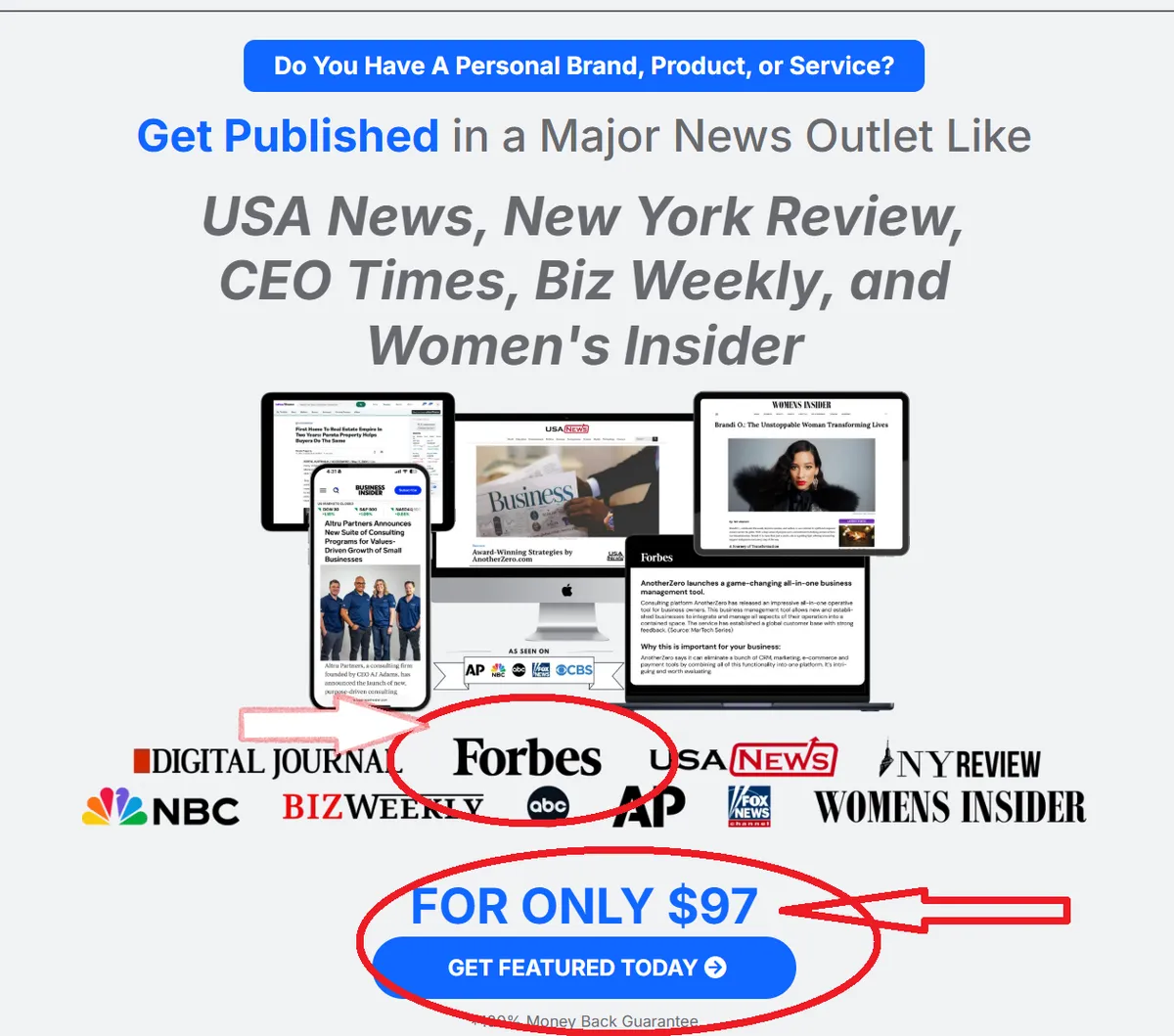
Will $97 Really Get My Business Featured in a Major News Outlet?
You've probably seen the advertisements.
"Get Featured in a Major News Outlet!"
"Forbes! NBC! ABC! USA News!"
"Only $97!"
With recognizable media logos displayed prominently, it sounds like an incredible opportunity.
But before reaching for your credit card, there's a question worth asking.
Am I paying for a full article about my business or simply press release distribution?
What's Actually Included in That $97 Offer?
Here's what caught my attention about one advertisement.
It promoted the opportunity to get featured in a major news outlet for $97, surrounded by recognizable publication logos.
But it wasn't until clicking through that the service was described as a press release.
That's a significant distinction.
A press release is promotional information prepared about a business and distributed to media outlets.
An independently reported article involves a journalist or publication developing a story through its editorial process.
Both can provide exposure. But they're different services, and buyers deserve to know which one they're purchasing.
Can I Really Get Published in Forbes for $97?
It's worth examining the costs.
According to a 2026 pricing comparison published by S99 PR:
Earned editorial coverage: Forbes doesn't charge for publication, but there's no guaranteed outcome. A journalist or contributor decides whether to cover your business.
PR agency services: Agencies may charge thousands of dollars to pursue coverage. S99 PR advertises a Forbes USA article service at $7,997.
Forbes Councils: Reported membership costs range from approximately $2,500 to $6,800 annually, plus an initiation fee. Publication isn't guaranteed.
Forbes BrandVoice: Sponsored publishing programs have reportedly cost $50,000 or more monthly.
These are reported prices, not an official Forbes rate card.
Source: S99 PR, Cost to Get Featured in Forbes (2026)
So when an advertisement displays the Forbes logo alongside a $97 offer, ask whether an actual Forbes placement is included.
Being offered publication in one of several outlets isn't the same as being guaranteed publication in the one that attracted your attention.
Are Press Releases and Contributor Articles Legitimate?
Absolutely.
Press releases have a legitimate role in communicating business announcements.
Contributor publishing is also an established distribution model.
For example, MSN publishes content supplied by approved publishing partners and contributors. JCH Digital Growth uses contributor distribution for MSN placements.
The issue isn't whether these publishing arrangements are legitimate.
The issue is whether the advertisement accurately explains what's being sold.
A press release, contributor article, sponsored feature, and independently reported news story aren't interchangeable.
What's the Difference Between a $97 Press Release and an Authority Campaign?
A $97 press release service may distribute one announcement across a network of publishing websites.
That's useful when your business has news to announce.
But distributing one press release isn't the same as creating a campaign built around the questions prospective customers are researching.
At JCH Digital Growth, we take one core topic and develop it into eight different content formats, each created for its intended publishing channel.
Those formats are then distributed across 300+ websites, with expanded packages reaching 1,500–2,000+.
The difference isn't simply the number of publications. It's the information buyers encounter.
A press release communicates an announcement.
An authority campaign provides potential customers with relevant answers across multiple channels, including articles, audio, video, and other formats.
That creates more opportunities for buyers to discover your business, recognize its expertise, and develop confidence before making contact.
One distributes an announcement. The other builds recognition and authority through strategically placed, buyer-focused content.
Both have value. But they're different services, and comparing them on price alone misses the point.
What Should I Ask Before Paying for Media Coverage?
Before purchasing any media package, ask:
Am I purchasing a full article or a press release?
Which publications are guaranteed?
Is the content independently reported, contributed, sponsored, or syndicated?
Can I see examples of completed placements?
Will the content be adapted for different platforms?
Will I receive links verifying where it was published?
What happens if the promised placement isn't delivered?
If the advertisement promises a major media feature but the service delivers press release distribution, you should understand that distinction before paying.
So Is a $97 Media Package Worth Buying?
Possibly.
If you need an inexpensive way to distribute a business announcement, a press release service may be appropriate.
But if you're expecting a journalist-written feature in a major publication, that's a different proposition.
The problem isn't the $97 price. It's the difference between what the advertisement leads you to expect and what you're actually purchasing.
Before buying media coverage, make sure you're paying for the result you want, not simply the impression created by a collection of famous logos.