

What Makes Content Shareable: The 5 Triggers Behind 85 Million Monthly Readers
BuzzFeed hit 85 million monthly readers not by out-reporting competitors, but by understanding why people share. Here's the data and the principles behind it.
In a talk at the 99U conference, BuzzFeed's Jonathan Perelman laid out exactly how they built a media company hitting 85 million monthly readers - not through better journalism alone, but by understanding how content travels.
Key Takeaways:
- The starting point online is the social feed - not search, not a homepage
- Content is the baseline; distribution is the multiplier
- Each platform behaves differently - match content type to channel
- Shareable content connects to identity, emotion, humour, or nostalgia
- Consistency builds the reflexes to act when moments appear
- Branded content works when it earns attention instead of buying it
- Mobile is not optional
- Understanding how content travels is as important as creating it
The web has moved through three distinct eras: portal, search, social.
In the portal era, you went to a homepage and consumed what was served. In the search era, Google was the front door - you typed a question and got an answer. Now? You check your phone before your feet hit the floor. You scroll a feed. Nobody wakes up thinking, "What should I Google?" They open Twitter, Instagram, or Facebook and let the feed decide.
That's the starting point for everything that follows.
BuzzFeed built one of the fastest-growing media companies in the world by understanding this shift earlier than most. At their peak growth phase, they were pulling 85 million unique visitors a month with 200% year-over-year growth - not by producing better journalism alone, but by rethinking how content travels.
Here's what they learned, and what it means for anyone creating content today.
The Feed Flattened Everything
Before social, content had categories. The newspaper had sections: news, business, sports, arts. TV had schedules. Radio had formats. Audiences knew what to expect and when.
The feed destroyed all of that.
Open Facebook or TikTok right now and you'll see a photo of your nephew's birthday, a political opinion, a clip of someone's dog, a breaking news alert, and an ad - all in the span of 30 seconds. Content of wildly different types sits side by side, and people consume all of it without blinking.
This is not dumbing down. It's human nature. People have always cared about both serious news and trivial entertainment simultaneously. The 1960s New York Times saw circulation climb not because their reporting improved but because they added an Arts & Leisure section, a Dining Out section, and a Science Times. They started covering what humans actually care about.
The feed just made that reality impossible to ignore.
Content is King. Distribution is Queen. She Wears the Pants.
Great content that nobody sees is worthless. Average content with perfect distribution beats brilliant content sitting in a dark corner.
BuzzFeed proved this with hard numbers. Take their post "Basset Hounds Running" - exactly what it sounds like: pictures of basset hounds running. Objectively simple. Here's what happened:
- 386,000 total views
- 12,000 came from BuzzFeed.com itself
- 374,000 came from social sharing
- Social lift: 33x - meaning 33 times more people found it through shares than through the site directly
The top referral source was StumbleUpon, which picked it up and sent 95,000 visitors. Facebook drove another enormous share. Twitter? Just 5,500.
Now compare that to a 5,000-word longform piece about growing up in Ciudad Juárez, one of the most dangerous cities in the world. That story pulled 150,000 views in two weeks - but the traffic pattern was completely different. Most visitors came directly or through dark social (email, private sharing, third-party widgets). Twitter drove almost the same raw number as it did for the basset hounds post. Longform blogs and longform.org picked it up instead.
Same platform. Completely different content. Completely different distribution behaviour.
This is the core insight: understanding how content travels is as important as creating it.
The Platforms Are Not the Same
Each platform has its own physics. Treat them the same and you'll underperform on all of them.
Platform Twitter
Content Type Breaking news, timely takes
Lifespan 2-2.5 hours
Mechanism Retweet spike, then drops fast
Platform Facebook
Content Type Emotional, shareable stories
Lifespan Days to weeks
Mechanism Peer sharing, picks up slowly then sustains
Platform Pinterest
Content Type Visual, evergreen, aspirational
Lifespan 6 months to 2 years
Mechanism Discovery-driven, keeps delivering
Platform StumbleUpon
Content Type Quirky, surprising, entertaining
Lifespan Unpredictable bursts
Mechanism Random discovery
The basset hound post was Facebook content. The Juárez piece was email and longform-community content. Neither would have performed the same way if you'd tried to force them into the wrong channel.
What Actually Makes Content Spread
BuzzFeed identified a set of principles behind shareable content. These aren't tricks - they're grounded in why people share things at all.
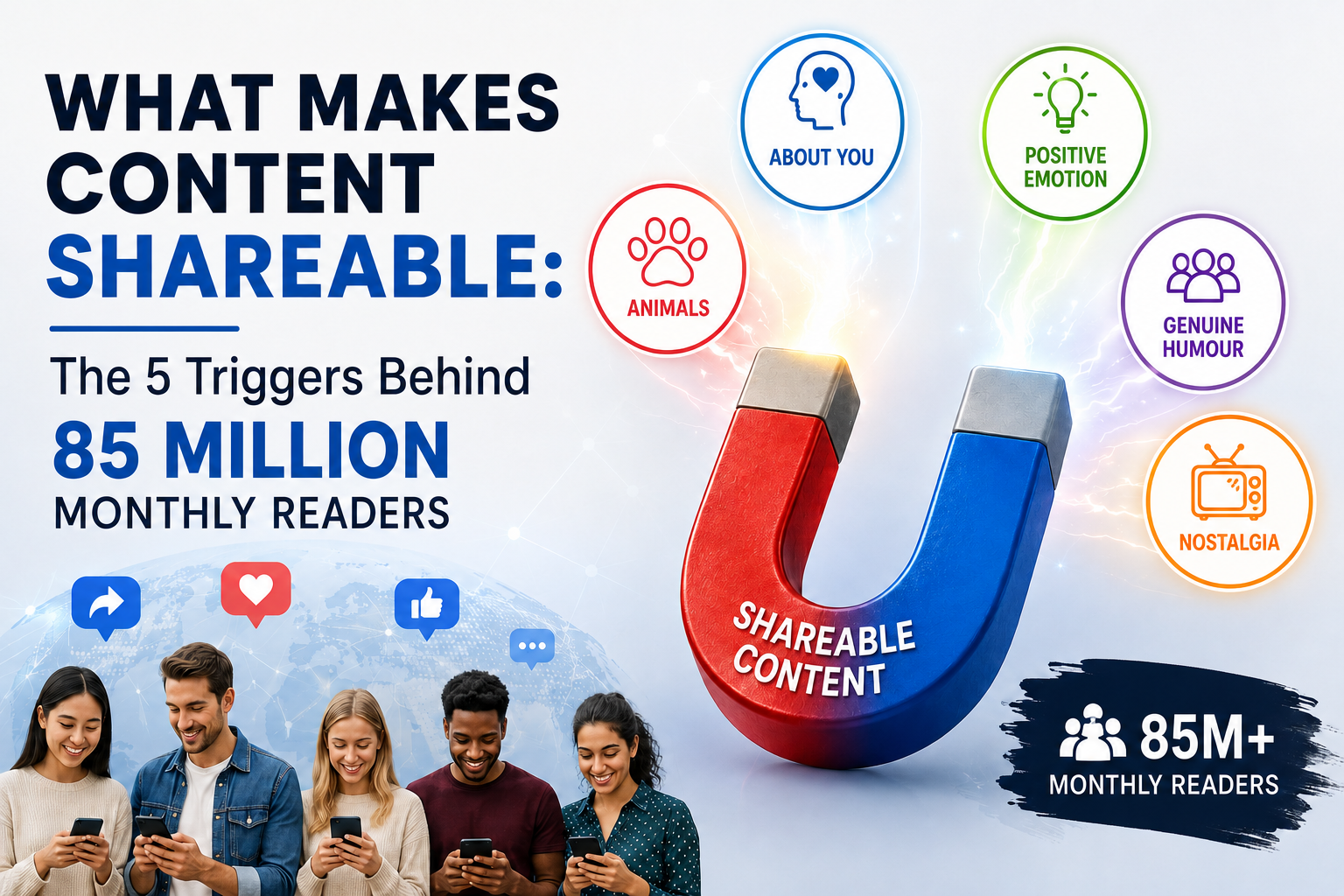
- People share to express identity. Content that says something about who you are gets shared. A post about the 18 struggles of being left-handed went viral on International Left-Handers Day - not because it was breaking news, but because left-handed people sent it to other left-handed people as a badge of recognition. It had been published two years earlier and suddenly spiked again.
- Positive emotion travels further than negative. Fear, outrage, and anger can drive clicks. But joy, nostalgia, humour, and awe drive shares. People want to be the one who made their friend laugh today, not the one who made them anxious.
- Humour works - if it's genuine. "Printer error code 404: motivation not found." People share things like this because being funny in your network carries social currency.
- Nostalgia is a cheat code. Ask someone to remember the smell of Nivea sunscreen and watch how many post about childhood beach trips. Content tied to shared childhood memories triggers an almost involuntary urge to tag someone or forward a link.
- Animals are not optional. Specifically cats, but animals in general. This isn't a joke - it's an observable pattern in how content spreads. Understanding it is the difference between dismissing it and using it.
The Oreo Lesson: Muscle Memory Wins
Everyone remembers the Oreo Super Bowl tweet - the one posted during the blackout that said "You can still dunk in the dark." It got more press than Oreo's actual Super Bowl ad.
What most people miss: that tweet was possible only because Oreo had spent 365 days before it creating one new piece of on-brand content every single day for their 100th anniversary campaign. By day 372, their team had the reflexes to act within minutes. It wasn't a lucky break. It was 371 days of practice paying off on day 372.
The lesson isn't "be clever on social media." The lesson is: consistency builds the capability to capture moments. You can't manufacture that reflex in a crisis.
Word-of-Mouth at Internet Scale
We used to live in a broadcast model: a handful of networks reached millions. Now, anyone with a Twitter or Facebook account can send something across the web to an audience that rivals the nightly news.
This is peer-to-peer influence at scale. The recommendation from a friend carries more weight than any ad. BuzzFeed's data showed this repeatedly - the most valuable traffic wasn't the traffic they drove. It was the traffic their readers drove for them.
This is word-of-mouth marketing - the oldest and most trusted form of marketing - running at internet speed and scale. That only happens when the content is worth passing along.
How Brands Fit In
BuzzFeed's approach to brand content followed the same logic. Instead of banner ads (you're statistically more likely to summit Everest than click one), they created content for brands that told a story worth reading.
Two examples:
Toyota Prius didn't lead with "buy a hybrid." They ran a post on the 20 coolest hybrid animals - ligers, zebroids, narwhals. Buried in the storytelling was the implicit message: hybrids are fascinating, not boring. The scenic drives piece that followed pointed out, casually, that those drives pass through areas with long stretches between gas stations - which is where a hybrid shines.
GE wanted to communicate Timeless Technology. So BuzzFeed created content for every decade from 1890 to the present, with GE's original period ads embedded as the ad unit. The content was genuinely interesting. The brand was woven in, not bolted on.
The principle: tell a story that your audience wants to read, and let the brand live inside that story.
The Mobile Piece Nobody Can Ignore
Over 50% of BuzzFeed's traffic at the time was mobile - and growing. Every piece of content has to work on a small screen, viewed while standing in a Starbucks queue with a coffee in one hand.
Think of it as the "standing in line" network. Hundreds of millions of people killing 90 seconds with their phones every morning. If your content doesn't render, load, and land in that context, it doesn't exist.
The final test before publishing anything: Would you be proud to share this with your own network? If the answer is no, it's not ready.
If it doesn't spread, it's dead.
This article draws on insights from Jonathan Perelman's talk "Content Is King, But Distribution Is Queen" published on YouTube. Watch the original here: Jonathan Perelman: Content Is King, But Distribution Is Queen - YouTube
Ready to see where your authority stands?
Your name can be visible and still fail to create trust before comparison begins.
If you want to understand how your current authority signals are working, start here.
Request an Authority Compatibility Audit below
Request an Authority Compatibility Audit
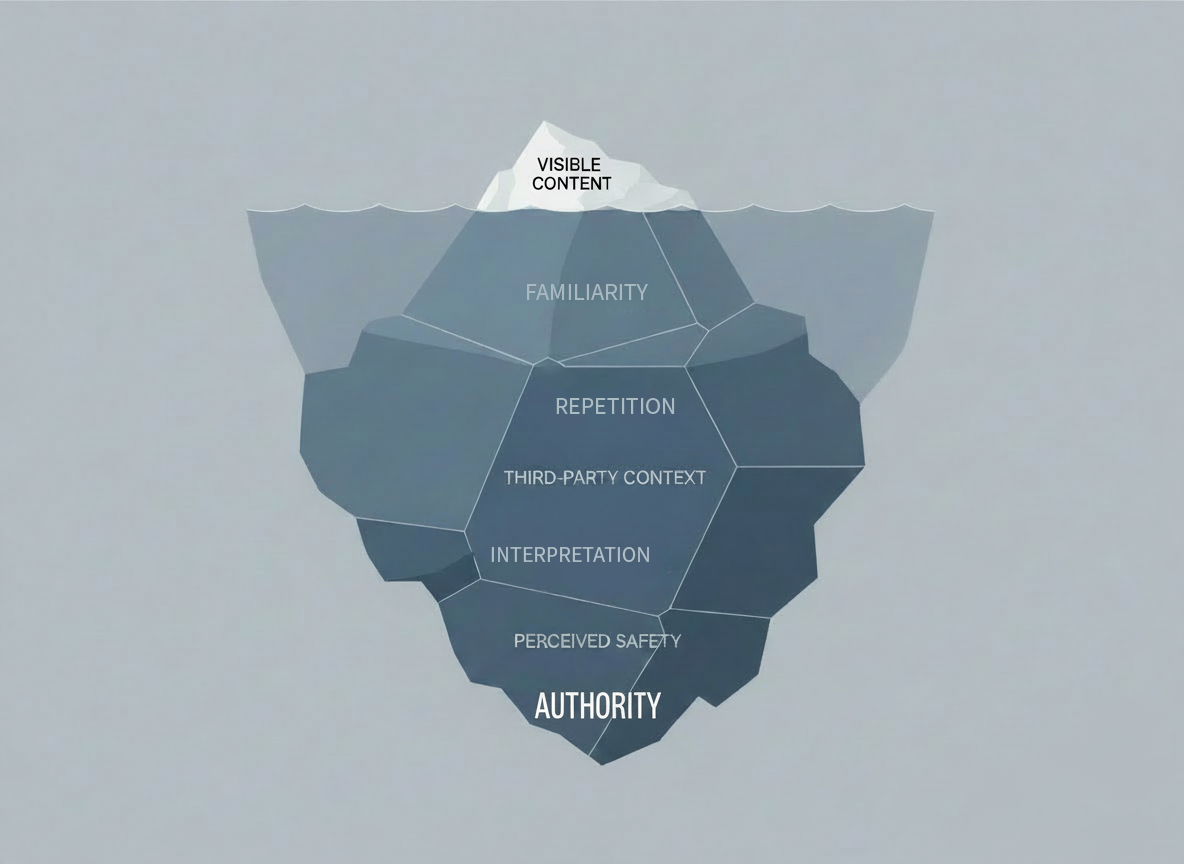
Most decisions are made before outreach. Explore how authority, repetition, and context shape trust long before buyers compare options in our Digital World.
Channel Authority Insights for Business